
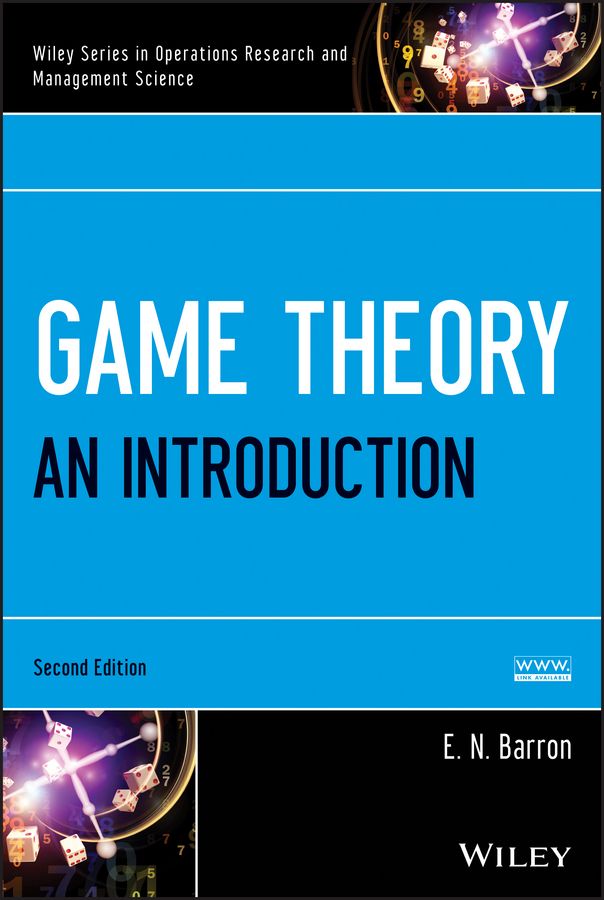
<p><b>An exciting new edition of the popular introduction to</b> <b>game theory and its applications</b></p> <p>The thoroughly expanded <i>Second Edition</i> presents a unique, hands-on approach to game theory. While most books on the subject are too abstract or too basic for mathematicians, <i>Game Theory: An Introduction, Second Edition</i> offers a blend of theory and applications, allowing readers to use theory and software to create and analyze real-world decision-making models.</p> <p>With a rigorous, yet accessible, treatment of mathematics, the book focuses on results that can be used to determine optimal game strategies. <i>Game Theory: An Introduction, Second Edition</i> demonstrates how to use modern software, such as Maple™, Mathematica®, and Gambit, to create, analyze, and implement effective decision-making models. Coverage includes the main aspects of game theory including the fundamentals of two-person zero-sum games, cooperative games, and population games as well as a large number of examples from various fields, such as economics, transportation, warfare, asset distribution, political science, and biology. The <i>Second Edition</i> features:<br /> <br /> • A new chapter on extensive games, which greatly expands the implementation of available models<br /> <br /> • New sections on correlated equilibria and exact formulas for three-player cooperative games<br /> <br /> • Many updated topics including threats in bargaining games and evolutionary stable strategies<br /> <br /> • Solutions and methods used to solve all odd-numbered problems<br /> <br /> • A companion website containing the related Maple and Mathematica data sets and code</p> <p>A trusted and proven guide for students of mathematics and economics, <i>Game Theory: An Introduction, Second Edition</i> is also an excellent resource for researchers and practitioners in economics, finance, engineering, operations research, statistics, and computer science.</p>
Business and Management, Economics, Mathematics
Game Theory
₹8,702.00
An Introduction
This book is currently not in stock. You are pre-ordering this book.